Finding Your Artistic Voice · GoldBrush AcademyContents
GOLD BRUSH ACADEMY
A complimentary handbook · The Thinking Artist
Finding Your Artistic Voice
A field guide for painters who have the skill, and are ready to build a body of work with a signature style and something to say.
Madhubanti Mukherjee · GoldBrush Academy
Scroll to begin
Finding Your Artistic VoiceBefore you begin
Before you begin
How to use this book
This is not a style guide. Nobody can hand you a voice, and a voice borrowed from someone else wears thin within a season.
What follows is a set of ideas, case studies and exercises that help you find the voice already moving through your work, and then give it the conditions to grow. The book moves in four parts. The first draws a clear line between a good painting and a body of work, and between style, voice and visual language. The second looks at what a voice is actually made of, and at a handful of masters who found theirs by returning, again and again, to one question. The third is practical: seven exercises, from twenty minutes at the floor to a ten-painting series. The fourth is about reading your own work honestly and sustaining the thread over months and years.
Read it once, straight through. Then come back to Part Three with a pencil. The exercises work best spread across several weeks; the answers change as you do, and the way they change is the most honest map of your growth.
You will need
A notebook you will keep for a year · a soft pencil · your last twelve finished paintings (or photographs of them) · a wall or floor where you can see them together · about three hours across the first two weeks.
Fill it in
The write-in lines on the exercise pages work on screen, and what you type stays on your own device. Or use Save as PDF / Print at the top and work on paper, which most painters prefer.
Go into yourself.Rainer Maria Rilke · Letters to a Young Poet, first letter, 1903
Rilke gave that advice to a young writer who had asked whether his poems were any good. He refused to judge them, and sent him inward instead. It is still the right place to start.
A painting can be beautiful and still be alone. A body of work is paintings that have begun to speak to one another.
1
Part One · Seeing the differenceChapter 1
01
Chapter one
The sampler and the sentence
Hang twelve beautiful, unrelated paintings on one wall and they read like a sampler: proof of range, not a statement.
A sampler is an honest object. It shows that the hand can do many things: a rose here, a harbour there, a portrait, an experiment with salt. For a while in every painter's life it is exactly the right thing to make. But a sampler answers only one question, can you paint?, and after a certain point that question has been answered.
A body of work answers a different question. It says: this is what I keep looking at, and this is what I have found there. Put twelve paintings from a real body of work on one wall and something strange happens. The paintings begin to explain each other. A choice that looked accidental in one becomes deliberate when it recurs in the third and the seventh. A viewer who would have walked past any single sheet stops, because the wall has become a sentence someone is still writing.
What a body of work is not
It is not
Because
A set that matches
Matching is decoration. Twelve paintings in the same palette can still say nothing to each other.
A single subject
Subjects are where the work lives. Ten lotus ponds can be ten separate thoughts.
A signature technique
A trick repeated becomes a brand. It is recognisable, and it wears out quickly.
A number
There is no magic count. The advisor Alyson Stanfield refuses to give one, and she is right.
What turns separate paintings into a body of work is not sameness but continuity of inquiry: a question held steady across many sheets of paper, long enough that the paintings begin to answer it together.
Key pointerA body of work is not paintings that look alike. It is paintings that think alike.
2
From the mastersPlate I
From the masters · Plate I
The Blue Rigi, Sunrise
J. M. W. Turner · 1842 · Watercolour on paper · Tate, London
In 1842, in his late sixties, Turner made a group of watercolours of the Rigi seen across Lake Lucerne at different hours of the day: this blue dawn, a dark version and a red one. The mountain hardly changes from sheet to sheet. The air around it is the whole subject.
Look forHow little is drawn. The mountain is one soft blue shape; the painting lives in the gradations of sky and water around it.
3
Part One · Seeing the differenceChapter 2
02
Chapter two
Style, voice and visual language
Three words the art world uses almost interchangeably. Untangling them is the first real step.
Term
What it is
Can it be copied?
Style
The how: palette, line, brushwork, edges, composition, medium.
Yes, and easily
Voice
The what and why: what you notice, value and want to say.
No. Only you have lived it
Visual language
The signs, motifs and formal choices that carry a voice to a viewer.
The vocabulary is shared; the sentence is yours
The painter and teacher Carol Douglas puts the difference in one line: "Your voice comes from who you are, not what you do." The illustrator Lisa Congdon describes voice as all of it together (palette, symbols, marks, skill, subject, medium) held consistently and reflecting your perspective and values. Style is one part of voice, not a synonym for it.
Princeton University Art Museum's drawing programme frames it experientially: "Separate from style, voice is the entirety of the artist coming through the work to reach the viewer." A seasoned painter is not more gifted; they are more practised at letting the voice through.
A useful sense of scale
Think of voice as your entire body of work, and a style as one series within it. That is why mature artists can work in several styles without losing themselves. Copy someone's palette and you have borrowed a word, not their sentence.
Key pointerStyle is the skin. Voice is the source. Visual language is how one reaches the other.
4
Part One · Seeing the differenceChapter 3
03
Chapter three
Skill is the floor
Line, value, edges, light, colour, composition. All of it is learnable, and you need all of it.
Nothing in this book argues against craft. Skill decides whether a wash stays clean, whether a shadow holds its weight, whether the eye travels where you meant it to. Without it, even the most interesting question arrives on the paper as mud. In watercolour especially, where the medium punishes hesitation and rarely forgives a second attempt, craft is the price of admission.
But skill has a ceiling of its own. It can make a painting better. It cannot tell you which painting to make next, or why. Many accomplished painters reach a strange plateau here: every year the work improves, and every year it feels a little less theirs.
The gap, and the other gap
The broadcaster Ira Glass famously described the frustration of beginners: their taste is good long before their ability catches up, and for years their work disappoints them. The cure, he said, is volume: a great deal of work, over a long time.
There is a second gap that arrives later and is talked about far less. It opens when ability has caught up with taste, when you can paint almost anything well, and yet the work still does not feel like yours. Volume alone does not close this one. It closes only when the work acquires a direction.
What skill gives you
What it cannot give you
Clean, controlled washes
A reason to paint this subject rather than another
Convincing form and light
A point of view about that light
Composition that holds
A thread that holds twelve compositions together
Confidence at the easel
Knowing when a series is finished
Key pointerSkill is the floor. The question is what you build on it.
5
From the mastersPlate II
John Singer Sargent · Simplon Pass: The Lesson · 1911 · Watercolour · Museum of Fine Arts, BostonWinslow Homer · The Blue Boat · 1892 · Watercolour over graphite · Museum of Fine Arts, Boston
From the masters · Plate II
Two virtuosos who chose
Above: John Singer Sargent · Simplon Pass: The Lesson · 1911 · Watercolour. Below: Winslow Homer · The Blue Boat · 1892 · Watercolour over graphite. Both Museum of Fine Arts, Boston
Both could paint anything. Sargent, famous for his society portraits, grew tired of commissions and from around 1907 painted largely for himself: friends and family sketching in the Alps, travelling companions, water and stone. Homer spent summers in the Adirondacks and painted the guides, boats and lakes there again and again. In both, skill is not the subject. It is the floor the voice stands on.
6
Part One · Seeing the differenceChapter 4
04
Chapter four
Six myths that keep painters stuck
Each is a specific, nameable trap. Most painters are standing in at least one of them.
1 · "A style is a fixed look I must lock down"
The premise is false. A style is a moving target, because you are moving. Advice to settle on one signature look ignores how artists grow. The real target is a consistent voice that can speak through changing styles, the way a person keeps one voice across a whole life of different sentences.
2 · "Similar palette and subject means similar art"
Two painters can share pigments, motifs, even a genre, and still make work that is unmistakably their own, because the difference lies beneath the surface: in perspective, experience and values. A shared palette is a shared vocabulary, not a stolen identity.
3 · "Originality means something never seen before"
Perhaps the most paralysing myth. Complete originality is neither possible nor necessary. What we call an original style is usually a distinct blend: familiar pigments mixed in a way no one else quite thought to mix them. The better question is not is it new? but is it honest? Are you painting your way of seeing, or recreating someone else's?
Authenticity asks more of you than originality does, and gives far more back.
7
Part One · Seeing the differenceChapter 4, continued
4 · "Copying and influence are cheating"
Copying is one of the oldest ways to learn; the ateliers were built on it. The distinction that matters is between inspiration, which studies the principles and decisions behind admired work, and imitation, which copies the surface without understanding it. Influence becomes a problem only when imitation is the destination rather than a stage. The healthy arc runs: learn, experiment, adapt, and a voice emerges.
5 · "Style arrives in a flash"
Most serious artists work from a sustained, sometimes lifelong investigation, not a single bright idea. One of the commonest mistakes is forcing a style too quickly; a recognisable approach usually takes years. Voice is revealed by practice and reflection, not by revelation.
6 · "Trends and approval will build my identity"
Our era adds its own obstacles: approval culture on social media, the pressure of likes, and a life with very little silence in it. Changing styles to follow what performs this month, and seeking approval rather than satisfaction, both pull the voice outward, toward the audience, and away from its source.
The myth (surface thinking)
The reality (voice thinking)
Find one fixed style
Cultivate a consistent voice across evolving styles
Same palette means copying
Voice differentiates beneath the surface
Invent the never-seen
Authenticity matters more than originality
Influence is cheating
Influence is raw material; imitation is only a stage
Style is a flash of inspiration
Style is a sustained investigation over years
Chase trends for identity
Silence, reflection and self-knowledge build voice
Key pointerEvery myth looks at the surface. Every reality looks at the source.
8
Finding Your Artistic VoicePart Two
II
Part Two
What a voice is made of
A voice is not invented at the easel. It is uncovered there, one returning question at a time.
9
Part Two · What a voice is made ofChapter 5
05
Chapter five
Style is a residue, not a target
Chase a style and you get a trademark. Follow a question and you get a voice.
Most painters, at some point, ask the question what is my style? It is a natural question and a misleading one, because it treats style as something you choose from the outside, like a font. Style chosen that way hardens into a set of habits: the same wet-in-wet sky, the same splash of salt, the same palette, repeated because it once worked. Viewers recognise it, and very soon they stop looking.
A real style is closer to a residue. It is what remains on the paper after years of trying to see one thing clearly. It shows up in the decisions you make without deciding: where you leave paper white, how hard your edges are, what you refuse to include. You do not aim at it. You find it afterwards, the way you find your own handwriting.
Five questions to outgrow
The question
Why it is too shallow
"What's my style?"
Looks at the surface. It asks for an effect instead of a direction.
"What do I like painting?"
Looks at comfort. Useful for starting, limiting for growing.
"What looks good together?"
Looks at matching. Paintings can match and still say nothing to each other.
"What do people like?"
Looks at the audience. It hands your voice to someone else to hold.
"What subject do I keep returning to?"
Closer. But a subject is where the work lives, not what it is asking.
None of these is wrong; each yields something useful. They are simply too shallow to build a practice on.
Key pointerYou do not choose a style. You earn it, and you notice it afterwards.
10
From the mastersPlate III
From the masters · Plate III
Wheatfield with Crows
Vincent van Gogh · July 1890 · Oil on canvas · Van Gogh Museum, Amsterdam
Painted at Auvers-sur-Oise in the last weeks of his life. What makes it unmistakably his is not the subject, which is wheat, sky and birds, but the handwriting: every stroke a separate, directional decision, colour laid down thick and left alone. He did not set out to invent a style. It is what remained after years of trying to see.
Look forThe three paths that lead nowhere, and the way the sky is built from the same kind of mark as the wheat.
11
Part Two · What a voice is made ofChapter 6
06
Chapter six
The investigation
Roses, forts, faces, rivers: these are subjects. An investigation lies underneath them.
The investigation is the question your hand keeps asking, whatever happens to be in front of you. It is rarely about what you paint and almost always about how the world appears to you: how light behaves, how memory alters a place, how form holds or dissolves, how much can be left unsaid. Subjects can change from one season to the next. The investigation carries through them, and binds them, so that ten very different paintings read as one argument.
A subject
An investigation it might carry
A lotus pond at dusk
How light behaves on something about to disappear
An old house in the monsoon
What memory does to the edges of a place
A dancer mid-turn
Where stillness hides inside movement
A fort at noon
How weight and time settle into stone
A single rose, again
How little a form needs before it dissolves
Notice that any of those investigations could travel to a completely different subject. The dissolving rose and the dissolving fort can live in the same body of work. The matching lotus pond and the matching rose cannot, unless something deeper connects them.
Three prompts to find yours
1
2
3
Key pointerThe subject is the address. The investigation is who lives there.
12
Part Two · What a voice is made ofChapter 6, continued
A case in point
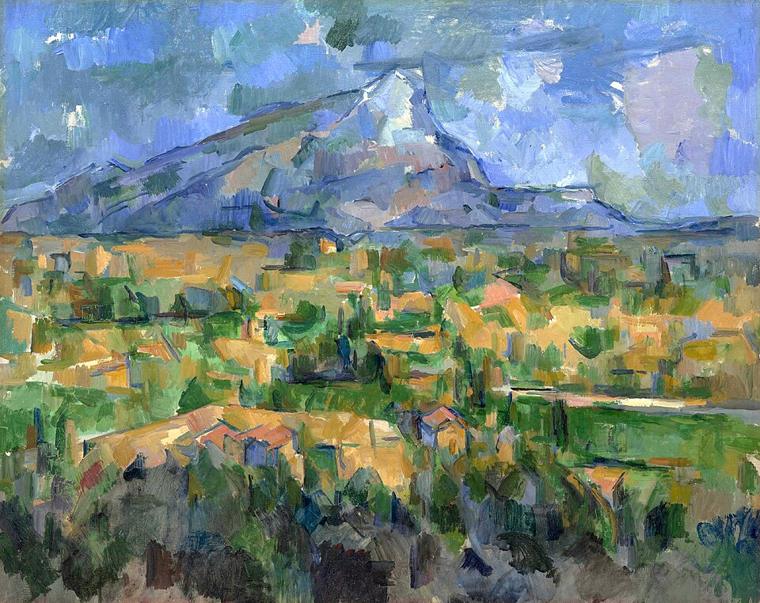
One mountain, for thirty years
Paul Cézanne, Mont Sainte-Victoire, c. 1904. Oil on canvas. Public domain.
Between about 1870 and his death in 1906, Paul Cézanne returned again and again to Mont Sainte-Victoire above Aix-en-Provence, in oil and in watercolour, by some counts around eighty times. He was not painting a mountain eighty times. He was pursuing one investigation: how the solid structure of the world could be built out of colour, patch by patch, without losing the living tremor of the moment he was looking at it. The late watercolours of the mountain are almost all paper, a few transparent touches holding up an entire landscape.
The philosopher Maurice Merleau-Ponty, in his 1945 essay Cézanne's Doubt, argued that Cézanne was trying to paint the world as it is actually perceived, before our habits of thought tidy it into objects and outlines. His life and his work, Merleau-Ponty wrote, were bound together without one simply explaining the other: "we are never determined and yet we never change." That line is as close to a definition of an artistic voice as any: free in every painting, and yet unmistakably the same person.
Key pointerReturn to one question long enough and it will teach you how to paint it.
13
From the mastersPlate IV
From the masters · Plate IV
One face, forty years
Rembrandt van Rijn · Self-Portrait · 1659 · Oil on canvas · National Gallery of Art, Washington
Rembrandt returned to his own face for about forty years, in paintings, etchings and drawings, dozens of times. The early ones are experiments with costume and expression. The late ones, like this, are an investigation of age, light and candour. The subject never changed. The question kept deepening.
Look forHow much of the canvas is left in near darkness, so that the light can gather on the brow and the eyes.
14
Part Two · What a voice is made ofChapter 7
07
Chapter seven
Three levels of meaning
Why palette and composition are never mere decoration.
The art historian Erwin Panofsky, in Meaning in the Visual Arts, set out the model art historians still use to read an image. Every work, he argued, speaks on three levels at once.
Level
What it asks
Pre-iconographic
What is literally there? A woman, a lamp, a river at dusk.
Iconographic
What do these forms mean by convention? A lotus for purity; a lamp for knowledge.
Iconological
What fundamental attitude toward the world does the whole work reveal, often without the artist intending it, in its person, its period and its culture?
Panofsky's decisive point for painters is that form cannot be divorced from content. The distribution of colour and line, light and shade, volume and plane carries more than visual meaning. Many artists spend their energy optimising the first level, the surface, while the power of a painting lives at the third. Your edges, your whites, what you leave unpainted: these are not style choices sitting on top of meaning. They are the meaning, arriving by another road.
Key pointerYour palette is not decoration. It is a sentence the viewer reads before they know they are reading.
15
Part Two · What a voice is made ofChapter 8
08
Chapter eight
The message of the era
An honest voice cannot help carrying the age it lives in.
The idea that great art bears the message of its century runs back to Hegel, who saw art as one of the ways a culture comes to know itself, and artists not as isolated creators but as people formed by, and giving form to, their time. The German word for it, Zeitgeist, means simply "the spirit of the age". Historians rightly warn against overstating it, since no era is perfectly coherent. As a lens, though, it clarifies: movements were never defined by shared palettes, but by shared responses to their moment.
Movement
Its moment
The message it carried
Realism
Mid-nineteenth-century social upheaval
Everyday and working life, painted without embellishment
Impressionism
A Paris remade by industry and new boulevards
Perception itself: light, the fleeting, the modern city
Bengal School
Early-twentieth-century India seeking its own modernity
An art rooted in Asian traditions rather than borrowed from the academy
Modernism
War, machines, a century breaking apart
Fragmentation, alienation, the search for new meaning
The same holds for one painter. Your questions are shaped by the rooms, cities, screens and silences of your own years. Paint them honestly and the era comes along of its own accord. The strongest voices do not merely mirror their moment; they help define it.
Key pointerYou do not need to paint the age. Paint your question honestly, and the age will be in it.
16
From the mastersPlate VI
Raja Ravi Varma · There Comes Papa · 1893 · Oil on canvasAbanindranath Tagore · The Passing of Shah Jahan · 1902
From the masters · Plate VI
Two answers to one question
What should an Indian painting look like? Ravi Varma mastered European academic oil painting and turned it on Indian life and myth, and his lithographic press carried his images into homes across the country. Barely a decade later Abanindranath turned away from that academic route, looked back to Mughal miniature and then outward to Japan. Both were answering the message of their era. Each arrived at a different voice.
17
Part Two · What a voice is made ofChapter 9
09
Chapter nine
The masters who returned
Almost every lasting voice in art history was built the same way: by returning.
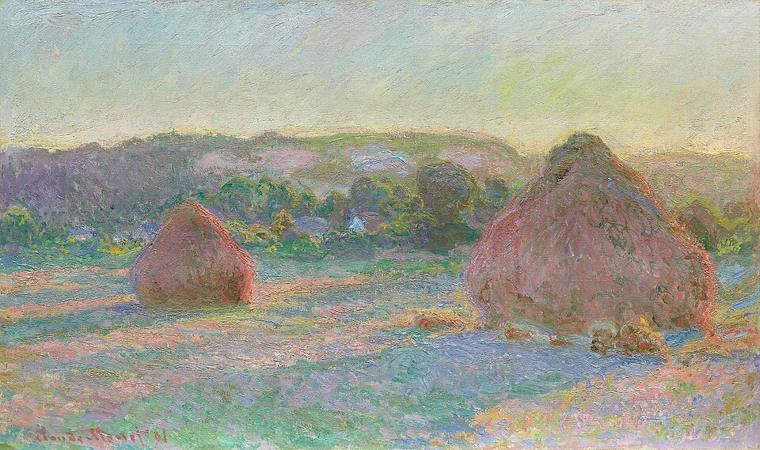
Claude Monet, Stacks of Wheat (End of Summer), 1890–91. Art Institute of Chicago. Public domain.
Monet and the stacks
From the late summer of 1890 into the spring of 1891, Claude Monet painted the grain stacks near his home at Giverny around twenty-five times: in frost, in haze, in snow, at noon and at sunset. When fifteen were shown together in Paris in May 1891, much of the show had already sold. His own account of how the project grew is disarming: "When I began I was like the others; I believed that two canvases would suffice, one for gray weather and one for sun!"
The stacks were never the point. Light was. The subject stayed nearly still so that the investigation could move freely.
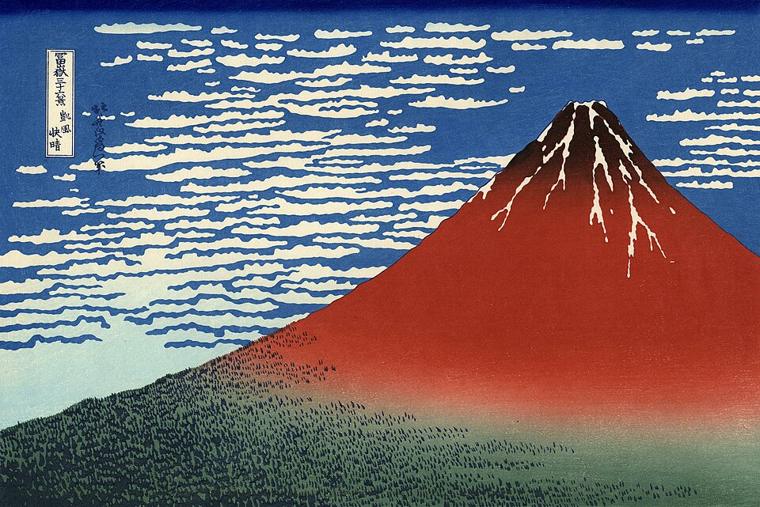
Katsushika Hokusai, South Wind, Clear Sky (“Red Fuji”), from Thirty-six Views of Mount Fuji, c. 1830–32. Public domain.
Hokusai and the constant mountain
Hokusai was in his seventies when he began Thirty-six Views of Mount Fuji, around 1830. The series was popular enough that ten more prints were added, forty-six in all. Fuji appears from fishing boats, from a cooper's workshop, through a wave; sometimes it is enormous, sometimes a speck. The mountain is the constant. Everything human moves around it.
Key pointerHold the subject still, and the investigation is free to move.
18
From the mastersPlate V
From the masters · Plate V
Stone, made of light
Claude Monet · Rouen Cathedral Façade and Tour d’Albane (Morning Effect) · 1894 · Oil on canvas · Museum of Fine Arts, Boston
In 1892 and 1893 Monet rented rooms opposite Rouen Cathedral and painted its west front more than thirty times, finishing the canvases in his studio at Giverny. Twenty were shown together in Paris in 1895. The most permanent thing in the city became a screen for the least permanent: morning light.
Look forThere are almost no hard edges. The Gothic detail is suggested by crusts of pale colour, not drawn.
19
Part Two · What a voice is made ofChapter 9, continued
Closer to home
A voice can be assembled
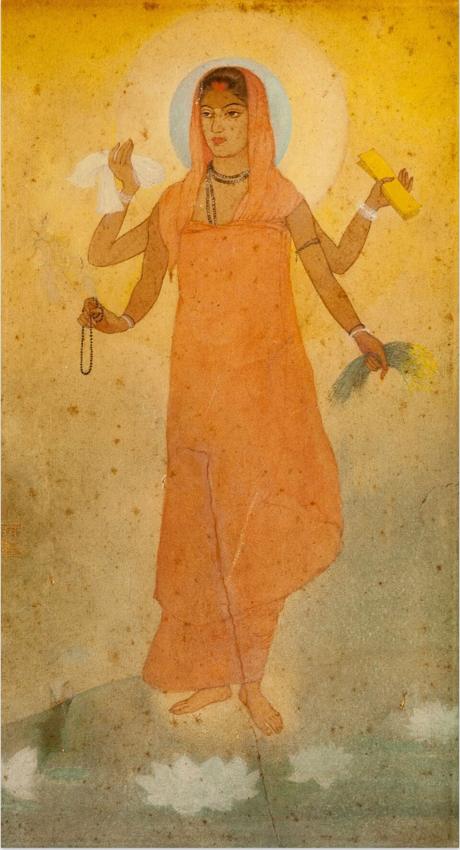
Abanindranath Tagore, Bharat Mata, 1905. Wash painting. Public domain.
Around 1902–03, the Japanese thinker Okakura Kakuzō visited Calcutta, and his students Yokoyama Taikan and Hishida Shunsō worked alongside the Tagore family. From them Abanindranath Tagore took up a Japanese wash method: colour laid in thin layers, then washed back under water, again and again, until the image seemed to breathe through a veil.
He did not copy it. He joined it to Mughal miniature, to Indian subjects and to his own longing for an art that felt rooted, and the result became the signature of the Bengal School. A borrowed technique, bent to a personal question, became one of the most recognisable voices in modern Indian painting.
Rabindranath Tagore and the late beginning
His uncle Rabindranath came to painting in 1924, in his mid-sixties, and not through a class. The doodles and crossings-out on his manuscripts began to join up into creatures, faces and scenes. His voice as a painter grew out of his own corrections. It is a useful reminder that a voice can arrive late, from an unexpected direction, and still be entirely one's own.
Morandi and the bottles
For most of his working life, Giorgio Morandi painted in a modest room in his family's apartment at Via Fondazza 36 in Bologna, and he painted, over and over, the same bottles, vases, bowls and tins. The narrowness was the freedom. With the subject settled, every painting could be about the space between things, the weight of pale light, the smallest shift in an edge.
Key pointerBorrow freely, but bend what you borrow to your own question.
20
Part Two · What a voice is made ofChapter 10
10
Chapter ten
Frida Kahlo: a private life, a public language
One case that shows every layer of this book at once.
Frida Kahlo's surface style is instantly recognisable: saturated colour, Mexican folk traditions, dreamlike juxtaposition. But her voice did not begin as an aesthetic choice. It grew from a life: a near-fatal bus accident at eighteen, decades of pain and repeated surgery, a turbulent marriage, and a fierce sense of Mexican identity. She put it plainly: "I paint myself because I am so often alone and because I am the subject I know best." No one could adopt that voice by adopting her palette.
A personal system of signs
Recurring motif
What it came to carry
Ribbons and veins
Connection, bloodline, the ties between people and bodies
Roots
Belonging to the land, to Mexico, to ancestry
Thorns, the broken column
Pain carried with dignity; a body under strain
Monkeys, parrots, dogs
Companionship, the household, a private cast of characters
This is visual language in Panofsky's full sense. Form cannot be separated from content, and the vocabulary is so consistent that viewers learn to read it across the whole body of work.
The private made universal
Her self-portraits are autobiography, and yet they raise larger questions about identity, gender and nation in post-revolutionary Mexico. That is the move this book is teaching: the personal, encoded honestly and consistently, becomes something strangers recognise as their own.
Kahlo's paintings remain under copyright and are described here rather than reproduced.
21
Part Two · What a voice is made ofChapter 11
11
Chapter eleven
Four sources of a voice
Your visual language is not your aesthetic. It is built from things only you are carrying.
Obsession
What you cannot stop noticing: a particular light, the edge where a wet wash meets dry paper, the silence of an empty courtyard. Obsessions are not chosen; they are confessed. Make a list and be honest.
Memory
The places, rooms and seasons that formed your eye before you ever held a brush. Memory is not a subject to illustrate but a filter; it decides what you see first and what you forgive.
Contradiction
Where you pull in two directions at once: control and surrender, precision and dissolve, tradition and restlessness. Contradictions are where a voice gets its tension. Do not resolve them too quickly.
Constraint
The limits you choose on purpose. They sound like the opposite of freedom, and they are one of its most reliable sources.
Why constraint works
The psychologist Patricia Stokes, in Creativity from Constraints, studied how painters, writers and designers made their breakthroughs. Her finding was that they tended to work with paired constraints: one that shuts out the familiar, easy solution, and one that pushes toward something new. Remove your favourite brush and your habitual palette, and you are forced to find another way to make the same idea. That other way is often where the voice appears.
The choreographer Twyla Tharp, in The Creative Habit, calls the hidden idea that holds a work together its spine. The audience may never name it, but they feel its absence immediately. Your investigation is your spine. Your constraints are how you keep it straight.
Key pointerYou do not invent a voice. You stop editing it out.
22
From the mastersPlate VII
From the masters · Plate VII
A voice that named itself
James McNeill Whistler · Nocturne: Blue and Gold – Old Battersea Bridge · c. 1872–75 · Oil on canvas · Tate, London
Whistler titled his paintings like music: nocturnes, symphonies, arrangements, harmonies. The titles were a manifesto. This is not a record of a bridge but a mood built from a very narrow band of tone. When John Ruskin attacked his nocturnes, Whistler sued, and in court he defended a picture painted in a couple of days as the product of “the knowledge I have gained in the course of a lifetime.”
Look forThe constraint: nearly one colour, a single gold note, and a composition that owes a great deal to Japanese prints.
23
Part Two · What a voice is made ofChapter 12
12
Chapter twelve
The line and the spiral
Improvement is a line. Inquiry is a spiral: it returns to the same place, one turn higher.
Improvement asks only one thing of each new painting: that it be better than the last. It is a straight climb, and it has a summit. When you reach it, the line goes flat. Inquiry asks something different: that each painting take the question one turn further. It keeps returning to the same ground (the same light, the same kind of edge, the same feeling) but from a little higher, seeing a little more. It has no summit. That is exactly why it can sustain a lifetime.
A metaphor from the physics of weather
When the meteorologist Edward Lorenz modelled convection in the early 1960s, he found a system whose path never exactly repeats and yet never leaves a recognisable shape. Mathematicians call such a shape a strange attractor. It is a useful picture of a mature voice: no two paintings are the same, none is predictable, and yet all of them orbit the same invisible form. Anyone who knows the work can recognise it at a glance, even though it has never repeated itself.
Key pointerA voice never repeats itself, and it never leaves home.
24
Finding Your Artistic VoicePart Three
III
Part Three
The practice
Seven exercises, from twenty minutes at the floor to a ten-painting series. Do them in order; each prepares the next.
E1
The floor test
20 minutes
E2
The sentence, five times
10 minutes
E3
The return list
30 days
E4
Study, don’t copy
two sessions
E5
The constraint series
6–8 weeks
E6
Pin the last one up
before every painting
E7
Your three sentences
one quiet hour
25
Part Three · The practiceExercise 1
E1
Exercise one
The floor test
Time · 20 minutesYou need · your last 12 finished paintings
Before you look for a voice, look at what is already there. It is usually closer than you think.
Lay the twelve paintings side by side on the floor, in the order you made them. If they are large or framed, use photographs printed at the same size.
Stand back, far enough that you cannot read detail. Do not judge any single painting. Look only at the whole.
Ask one thing: would a stranger guess these came from the same hand, and the same mind?
Pick up the three that feel most like you. Not the best three. The three most yours.
Write down what those three share that is not their subject: a light, a kind of edge, a mood, a way of leaving things out, a value range, a temperature.
Now look at the three you would least want to show. Write down what they share. Often it is the influence of someone else.
✦
✦
✕
Then · your reverse mood board
Instead of collecting other people’s work, pin up only your own pieces that feel most like you. From them, list three to five creative constants (recurring themes, motifs, colours or qualities of light) and keep that list where you paint.
What to look forYour voice is often already there, in the three, waiting to be noticed. The exercise is not to invent it but to name it.
26
Part Three · The practiceExercise 2
E2
Exercise two
The sentence, five times
Time · 10 minutesYou need · a pencil, no eraser
Finish the sentence below five times, differently each time. Do not name a medium, and do not name a subject.
Write quickly. The first answers are usually the polite ones: the answers you have heard other painters give, or the ones that sound good. By the fourth you will run out of polite answers. The fifth is usually the honest one.
1
2
3
4
5
Then, test it
Take your fifth answer and hold it against the three paintings you chose in Exercise 1. Does it describe them? If it does, you have a working hypothesis for your investigation. If it does not, do not force it; the gap between what you say and what you paint is itself information. Note it, and come back to this page in a month.
What to look forCircle the fifth answer. It is usually the honest one.
27
Part Three · The practiceExercise 3
E3
Exercise three
The return list
Time · one line a day, for 30 daysYou need · this page, or a small notebook
Every time something pulls you to paint, write one line. Not the object. The quality that caught you.
You are collecting evidence, not ideas. "A tree" is an object; "the moment the last light leaves the top of a tree" is a quality. "Old doors" is an object; "paint peeling in layers, like time made visible" is a quality. One line, the same day, before you have time to make it sound better.
1
2
3
4
5
6
7
8
9
10
11
12
13
14
15
16
17
18
19
20
21
22
23
24
25
26
27
28
29
30
At the end of each week, read the list back and circle any word or quality that appears more than once. By the third week the list begins to repeat itself. That repetition is not a lack of imagination. It is your voice, asking for your attention.
✦
What to look forObsessions are not chosen; they are confessed. This page is where you confess them.
28
From the mastersPlate VIII
From the masters · Plate VIII
Study, don’t copy
Utagawa Hiroshige · Sudden Shower over Shin-Ōhashi Bridge and Atake · 1857 · Woodblock print, from One Hundred Famous Views of Edo
In 1887 Van Gogh copied this print in oil as Bridge in the Rain (after Hiroshige), and framed it with a border of Japanese characters. The copy taught him flat colour, steep diagonals and bold cropping. Within a year those lessons had dissolved into his own paintings at Arles. The image stayed Hiroshige’s. The lesson became his.
Look forRain as ruled lines, the bridge cut off by the edge of the sheet, and the dark band of sky pressing down.
29
Part Three · The practiceExercise 4
E4
Exercise four
Study, don't copy
Time · two sessions of an hourYou need · three paintings by three very different artists
Copy the decisions, not the pixels. Influence is raw material; imitation is only a stage.
Choose three paintings that stop you, by artists as unlike each other as possible: a master, a contemporary, and someone outside watercolour altogether.
For each, write down the decisions, not the look. How is the light made? Where are the hardest edges? What was left out? What is the emotional timing?
Make one small study of each, solving only the decision you most want to understand. Ignore everything else.
Now paint one piece of your own, from your own subject, that deliberately combines one decision from each. Originality most often emerges from exactly this kind of blend, filtered through your own hand.
Artist
The decision I want to understand
✦
What to look forIf the result looks like any one of the three, you imitated. If it looks like none of them and a little like you, you studied.
30
Part Three · The practiceExercise 5
E5
Exercise five
The constraint series
Time · 6–8 weeksYou need · 10 sheets cut to one size
Ten paintings. Three things held fixed. One thing free to move.
This is the heart of the book. It borrows the method of Monet's stacks and Morandi's bottles, and puts Patricia Stokes's paired constraints into practice. Fix enough that you cannot fall back on habit, and leave one door open so the investigation has room to travel.
Hold fixed (choose three)
Let one move
One sheet size and format for all ten
Time of day or season
A palette of three pigments only
Distance: near, middle, far
One subject or one motif
Wetness: from bone dry to soaking
One brush
How much is left unpainted
A fixed time limit per painting
The value key: high, middle, low
F
V
1
2
3
4
5
6
7
8
9
10
Sketch each painting as a small thumbnail above once it is finished, so you can see the whole run at a glance. Do not throw away the failures; the series is the unit now, not the sheet.
What to look forBy painting seven or eight, the constraint starts to feel like a language. When a quirk or “mistake” appears, ask: what if I did more of that?
31
Part Three · The practiceExercise 6
E6
Exercise six
Pin the last one up
Time · 5 minutes, before every new painting
This is how paintings begin to talk to one another.
Before you begin a new sheet, pin your previous painting where you can see it while you work.
Ask: what did it leave unresolved? What did it almost say?
Write the answer in one line on the back of the new sheet. That line is your brief.
Paint the reply. When you finish, pin the new one up, and repeat.
One painting asks; the next replies and asks something new. Some of them will disagree with each other, and that is healthy. A body of work is a conversation, not a matching set. Over a year, the lines on the backs of your sheets become a record of the investigation itself, often more revealing than the paintings on the front.
The brief, on the back of the sheet
←
→
What to look forIf the briefs start to repeat, you have not failed. You have found the spine.
32
Part Three · The practiceExercise 7
E7
Exercise seven
Your three sentences
Time · one quiet hour, after Exercise 5
If you cannot say what your work is investigating in three plain sentences, you are not yet ready to show it as a body of work.
This is not an artist statement for a gallery wall; those come later and are often over-written. It is a working statement for you, kept in plain language. Avoid words like explore, journey and unique; they sound like something and mean almost nothing.
Warm-up: free-write for fifteen minutes on why you paint, what obsesses you and what you want a viewer to feel. Underline the words that repeat; they are your raw material. Afterwards, read your three sentences aloud and cut a fifth of the words.
The template
1 · My work is investigating what .
2 · I look for it in where / through which subjects , and I paint it by how: the choices you keep making .
3 · It matters to me because why: the memory, question or contradiction underneath .
1
2
3
An illustrative example, not a model to copy
My work is investigating how light behaves on things that are about to disappear. I look for it in monsoon evenings, wilting flowers and old walls, and I paint it by leaving more paper than pigment and softening every edge that faces the light. It matters to me because the moments I remember most clearly are the ones I knew were ending.
33
Finding Your Artistic VoicePart Four
IV
Part Four
Reading and sustaining
Finding the thread is the beginning. Keeping hold of it, through good seasons and doubtful ones, is the work.
34
Part Four · Reading and sustainingChapter 13
13
Chapter thirteen
Read your work like a critic
The four-stage method art educators have used for decades, turned on your own portfolio.
The art educator Edmund Feldman's model of criticism is the most widely taught in art education. Its power is its order: it forbids you to judge until you have looked. Applied to your own paintings, it becomes a diagnostic tool for voice, because it separates what is on the paper from what you hoped was there.
1 · Describe
List what is literally there, without judgement: subjects, shapes, colours, the size and surface of the sheet. Pretend you are describing it to someone on the phone.
2 · Analyse
How do the elements relate? Line, shape, value, colour, texture and space; balance, rhythm, emphasis, unity. Where does the eye go first, and why?
3 · Interpret
What does it mean? What mood, feeling or idea does the whole produce, and which specific choices produce it?
4 · Judge
Only now: does it succeed at what it is trying to do? And is what it is trying to do the thing you are trying to do?
From observation to argument
A compact version runs in four links: feature → relationship → effect → claim. "The whites are all on the left" (feature) "and they mirror the dark mass on the right" (relationship), "so the painting feels suspended" (effect), "which is what my work keeps doing with stillness" (claim). When the claims start to repeat across paintings, you are no longer describing pictures. You are describing a voice.
F
R
E
C
35
Part Four · Reading and sustainingChapter 14
14
Chapter fourteen
The self-critique sheet
Use these questions on any finished painting, and on groups of three or four. Answer in writing.
Writing slows the eye down enough to see what the work is actually doing rather than what you hoped it would do. Keep your answers; reading them a year later is one of the most instructive things a painter can do.
#
Ask
Listen for
I
Beneath its subject, what is this painting really about?
Does the answer connect to your three sentences?
II
What did I decide not to paint, and why?
Omission is where a voice is most audible.
III
Which passage feels most like me? Which feels borrowed?
Borrowed passages usually look more "finished".
IV
What does this painting ask that the last one did not?
If nothing, you are repeating, not returning.
V
Where did I play safe?
Safety is where the habit took over from the question.
VI
If this were one chapter, what would the next be?
That answer is your next brief (Exercise 6).
Reading a group of paintings
Put three or four together and ask a seventh question: what conversation are these having? If you cannot hear one, look for the painting that is changing the subject; it is either the weakest of the group, or the beginning of your next series. Only you can tell which, and it is worth sitting with the question for a few days before deciding.
Key pointerA voice is a question held long enough to become visible.
36
Part Four · Reading and sustainingChapter 15
15
Chapter fifteen
Shaping a series of twelve
There is no correct number, but twelve is a good first horizon: enough to reveal a thread, few enough to finish.
Seed · 1–3
State the question plainly. These are often the most literal paintings in the series. Let them be; they are the foundations.
Variation · 4–8
Move the one variable. The investigation starts to generalise, and the constraint begins to feel like a language.
Tension · 9–10
Push against your own rules once. Break a constraint on purpose and see what the series can survive.
Resolution · 11–12
Paint what the series now knows. These are usually the paintings you could not have made at the start.
Curating: what to leave out
When you show the series, you will rarely show all twelve. Leave out the painting that is most admired but least related; it will pull the viewer's eye away from the thread. Keep one painting that is slightly unresolved; it shows that the question is still alive. Hang them so the eye travels from seed to resolution, and let the gaps between them do some of the talking.
Before you call a series finished
☐ I can state its question in one sentence. ☐ At least three paintings surprised me. ☐ I broke one of my own rules, on purpose, and learned something. ☐ The last painting could not have been made first. ☐ I know what the next series will ask.
37
From the mastersPlate IX
Johannes Vermeer · The Milkmaid · c. 1658 · Oil on canvas · Rijksmuseum, AmsterdamVilhelm Hammershøi · Interior, Strandgade 30 · 1900 · Oil on canvas
From the masters · Plate IX
Painters who stayed indoors
Fewer than forty paintings are attributed to Vermeer, most of them set in a few rooms and lit from a window on the left. Two centuries later in Copenhagen, Hammershøi painted the rooms of his own apartment at Strandgade 30 again and again, often with a single figure seen from behind. A narrow world, painted long enough, becomes a whole vocabulary: that is a series.
38
Part Four · Reading and sustainingChapter 16
16
Chapter sixteen
Seven traps
Every painter who builds a body of work meets most of these. Knowing their names makes them easier to step around.
The trap
How it shows up
The way out
Matching, not conversing
A series that looks unified and says the same thing twelve times.
Use Exercise 6; make each painting answer the last.
Repeating a success
One painting is loved, so you paint it again, and again.
Ask what it asked, not what it looked like.
Chasing the feed
The work drifts toward whatever did well online this month.
Reread your three sentences before you start.
Too many doors open
Five subjects, four palettes and three formats at once.
Close three doors (Exercise 5).
Leaving too soon
Abandoning a question after three paintings because it got difficult.
The difficulty usually arrives around painting four or five. Stay to twelve.
Borrowed finish
The most polished passages are the least yours.
Self-critique question III, every time.
Waiting to be ready
Postponing the series until skill feels "complete".
Skill is never complete. Start the series now, with the skill you have.
The danger is not a lack of beauty. The danger is too much beauty before the thought has earned it.
39
Part Four · Reading and sustainingChapter 17
17
Chapter seventeen
The inner work
Some of what blocks a voice is not technical at all.
The artist and educator Kate Kretz, in Art From Your Core, approaches voice almost the way a therapist would: first name the obstacles, then do the slow work of excavating what lies underneath them, then commit to a lifelong cycle of research and making. Research on how art teachers develop their own voices describes a similar arc: overcoming anxiety and fear, risking imagination, engaging the creative process, and finally re-imagining oneself as a practitioner rather than a student.
Five obstacles worth naming
Obstacle
A question to sit with
Early influences
Whose voice did I learn to paint in, and have I ever put it down?
Approval culture
Which painting would I make if no one would ever see it?
Money
What am I painting because it sells, and what am I painting because it matters?
No silence
When did I last spend an hour with a blank sheet and no screen?
No meaning
If this painting disappeared, what would be lost?
A practice of silence
Of all of these, the lack of silence may be the most modern and the most underestimated. A voice needs room to be heard, including by its owner. Try one hour a week in the studio with no music, no phone and no reference photograph: only the sheet, the water and whatever you notice. It will feel unproductive. It is where the return list gets its best entries.
Key pointerBefore you can hear your own voice, you have to turn down everyone else's.
40
Part Four · Reading and sustainingChapter 18
18
Chapter eighteen
A twelve-week plan
One way to put the whole book into practice. Two painting sessions a week is enough; if life interrupts, pick up where you were.
Weeks
Do
You will have
1
Exercise 1, the floor test, and your reverse mood board. Start Exercise 3, the return list.
Your three, named
2
Exercise 2, the sentence five times. Reread Chapters 2, 5 and 6.
A working hypothesis
3
Exercise 4, study don’t copy. Choose your constraints for Exercise 5.
A series brief
4–5
Seed paintings 1–3. Begin Exercise 6: pin the last one up.
The question, stated
6–8
Variation paintings 4–8. A weekly critique using Chapter 13.
The thread, visible
9
Tension paintings 9–10. Break one rule on purpose. One silent hour.
The limits of the idea
10–11
Resolution paintings 11–12. Close the return list and read it back.
A finished series
12
Hang all twelve. Exercise 7, your three sentences. Curate a set of eight.
A first body of work
Key pointerAt the end of twelve weeks you will not have found your voice for ever. You will have found the next question, which is better.
41
Finding Your Artistic VoiceAfterword
A last word
Style is not something you choose. It is what remains when you keep following one question.
Come back to these exercises in a month, and again in six. The answers will change, and the way they change is the most honest map of your growth as an artist. A voice, in the end, is simply attention that has been kept faithfully, sheet after sheet, until other people can see what you have been looking at all along.
Madhubanti Mukherjee · Founder, GoldBrush Academy
42
Finding Your Artistic VoiceWhat comes next
What comes next
Continue the work, in company
This handbook is the first page. When you want a mentor watching your decisions, not only your results, the academy has two paths.
Prime programme · 5 weeks
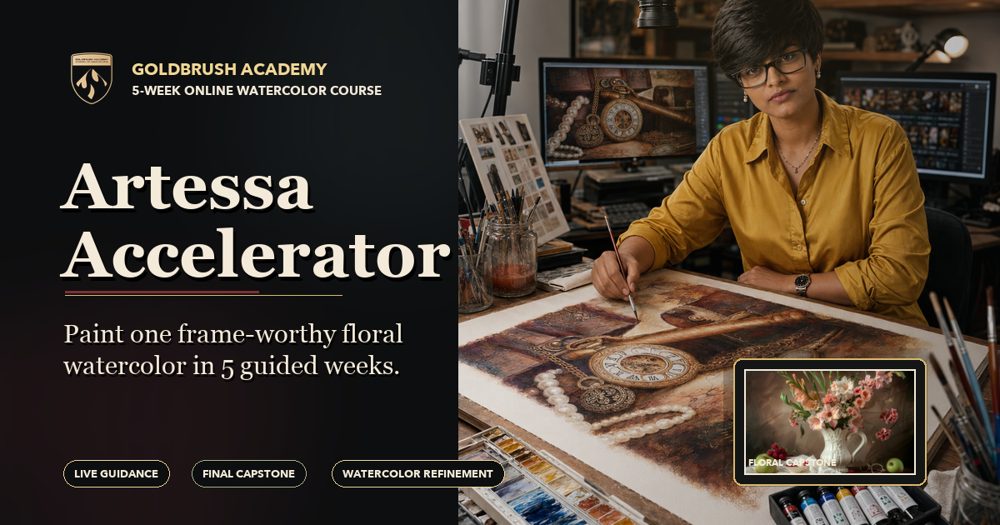
Artessa Accelerator™
The academy’s prime pathway for artists who want a career, not a hobby shelf. Five mentored weeks of values, water control, colour harmony, composition and layering, with personal critique, ending in a frame-worthy capstone painting.
Live studio Saturdays, 10:00 AM IST, with a 90-day replay
The academy’s longest commitment: not a course with an end date so much as an apprenticeship in judgment. It attends to the slow construction of a professional body of work, the paintings that belong together, and the artist who can defend them.
Long-arc mentorship with Madhubanti Mukherjee
For serious, advanced artists building a professional body of work
This handbook is free to keep, print and use in your own practice. Please do not republish it; send friends to the sign-up page instead, so they receive their own copy. Instagram @iws_goldbrush_academy.
43
Finding Your Artistic VoiceSources
Sources and further reading
Where these ideas come from
Voice, style and practice
Carol L. Douglas, "What does it mean to paint with your own voice?", watch-me-paint.com.
Princeton University Art Museum, "Art-Making: Drawing, Artistic Voice" (video session).
Lisa Congdon, writing on artistic voice; Nature Studio, "It's OK to work in more than one style".
Kate Kretz, Art From Your Core: A Holistic Guide to Visual Voice; interview, The Art of Education University, ep. 435.
"Finding Artistic Voice: Expressive Critiques Embedded in Teacher Education", Art and Learning Journal, Fort Hays State University.
"Revisiting Salient Themes in Signature Pedagogies for Arts Education", Springer, 2025.
Twyla Tharp, The Creative Habit (2003); Patricia D. Stokes, Creativity from Constraints (2005).
Alyson Stanfield, "How many pieces are in a body of work?", Art Biz Success.
Ira Glass on "the gap" between taste and ability (widely circulated interview).
Meaning, criticism and history
Erwin Panofsky, Meaning in the Visual Arts (1955), "Iconography and Iconology".
G. W. F. Hegel, Lectures on Aesthetics; and critiques of the Zeitgeist model in nineteenth-century art history.
Edmund B. Feldman's model of art criticism, as used in art education (ERIC, EJ1086252).
Maurice Merleau-Ponty, "Cézanne's Doubt" (1945), in Sense and Non-Sense.
Rainer Maria Rilke, Letters to a Young Poet (1903–08).
Edward N. Lorenz, "Deterministic Nonperiodic Flow" (1963).
Artists and works
Monet's grainstacks, Cézanne's Mont Sainte-Victoire and Hokusai's Thirty-six Views of Mount Fuji: museum catalogues and standard references; counts vary slightly between sources.
On the wash technique and the Bengal School: DAG, "Term of the Month: The Wash Technique".
Art Institute of Chicago, Tagore online catalogue, on Rabindranath Tagore's painting from 1924.
On Frida Kahlo: AMA Journal of Ethics, "Pain and the Paintbrush" (2013), and standard biographies.
Image credits
Paintings by Cézanne, Monet, Hokusai, Abanindranath Tagore, Turner, Sargent, Homer, Van Gogh, Rembrandt, Raja Ravi Varma, Whistler, Hiroshige, Vermeer and Hammershøi are reproduced from public-domain images on Wikimedia Commons; collections are named in the captions where known. The cover illustration and the author portrait on the sign-up page are AI-assisted images made for GoldBrush Academy. The watercolour grounds throughout are authored for GoldBrush Academy and are not reproductions of any painting. The works of Giorgio Morandi and Frida Kahlo are described but not reproduced.

 GOLD BRUSH ACADEMY