How Does a Watercolour Glow?
Light in a watercolour painting does not come from white paint, because there usually isn't any. It comes from paper the artist was disciplined enough to leave alone. The pigment is a thin, transparent filter: light passes through it, strikes the white sheet, and travels back up through the colour to your eye — so a watercolour glows exactly where the paper is still allowed to speak.
In my own watercolours, every highlight is untouched paper. I don't use any opaque white paints.
Luminosity is protected, not added
This is the part beginners find almost impossible to believe until they've ruined a passage learning it the hard way: luminosity in transparent watercolour is not something you add. It is something you protect, by planning, before the first wash ever touches the paper, exactly which small shapes need to stay untouched white for the rest of the painting to read as glowing. Once pigment covers that area, no amount of skilled work can put the light back — you cannot paint your way back to white paper, only toward an opaque approximation of it that reads, to a trained eye, as chalky rather than luminous. This single fact reorders the entire process. Where an oil painter can build light up gradually, layering brighter values over darker ones as the painting develops, a watercolourist has to reserve light in advance, which means genuinely luminous watercolours are usually the product of more planning than spontaneity, however spontaneous the final wash looks.
That planning is the real subject of the golden rule of watercolour — work light to dark, and leave the white alone. Glow is what that rule looks like when it succeeds.
Why the paper is the light
The optical mechanism underneath this is straightforward once you see it: watercolour pigment is largely transparent, so light passing through a thin wash bounces off the white paper beneath it and travels back through the pigment layer to the viewer's eye — the paper is functioning as the actual light source, and the pigment is functioning more like a coloured filter than like paint in the ordinary sense. This is why muddy, overworked passages look dead specifically — enough layers of pigment stacked on top of each other start to block that reflected light rather than filter it, and the passage stops glowing and starts merely sitting there, opaque, no matter how accurate the colour underneath.
So the question to ask of any passage is how long the path is between the paper and the eye. One transparent wash, laid once and left: a short path, and the passage breathes. Four layers worked back into while half-dry: a long path, and the light gives up on the way. Overworking is on the list of mistakes every beginner makes for exactly this reason.
Darkness is what makes the light
The practical consequence: the fastest way to make a passage look luminous is often not adding a bright colour. It's protecting more white, and surrounding it with enough real darkness nearby that the eye reads the contrast as light, the same way a candle looks brighter in a dark room than an identical flame does at noon.
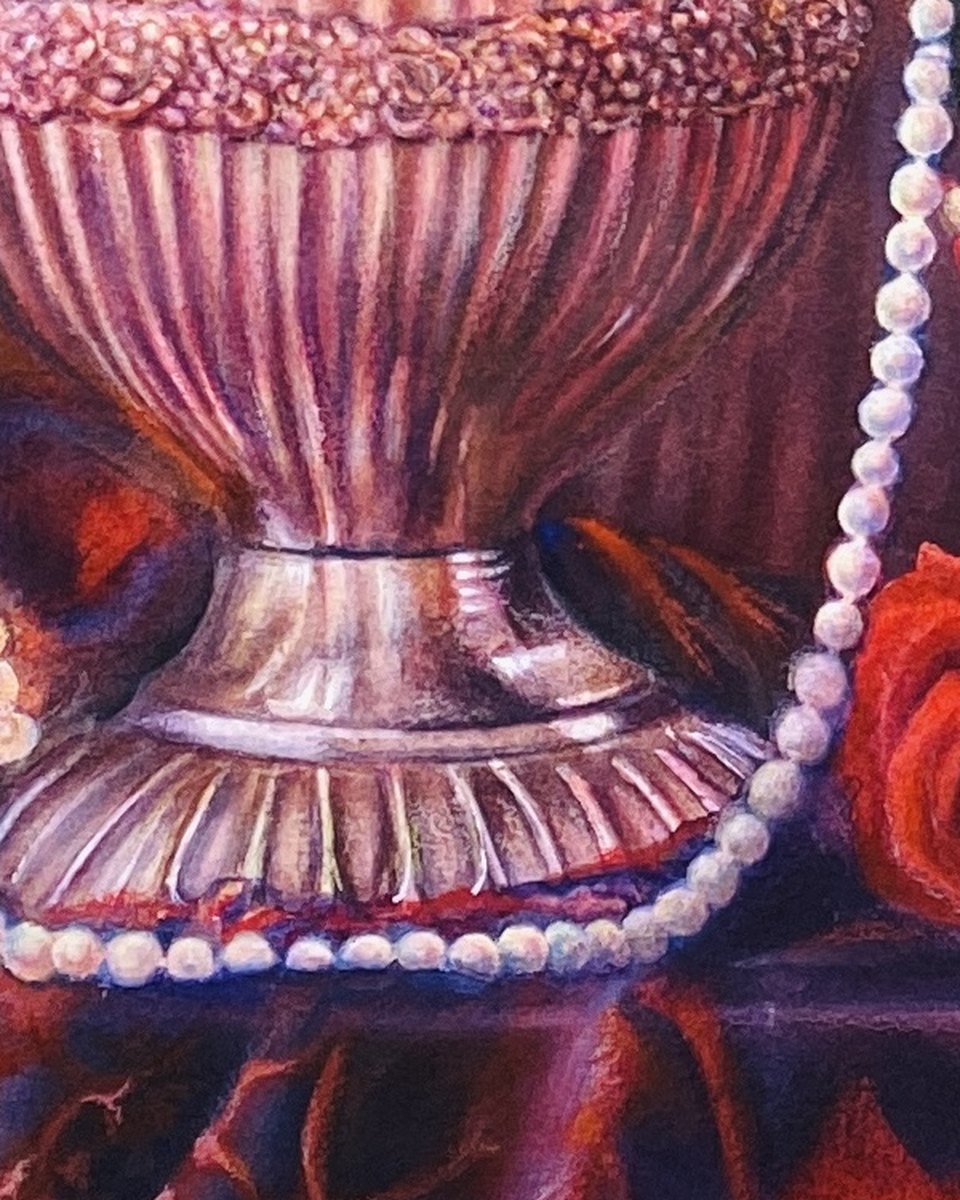
Look at the detail above. The brightest notes are tiny — a point on each pearl, a thin gleam along the rim of the metal. What makes them read as light is the deep wine and violet pressed right up against them. The paper is no brighter there than anywhere else on the sheet. Its neighbours are darker.
This is also why reserving whites is not the same as leaving a painting pale. A timid painting keeps plenty of paper and still does not glow, because nothing near the white is dark enough to make it matter. Glow needs both halves: the untouched light, and the committed dark beside it.
Try this before your next painting
Before your next wash, decide which three small shapes must stay untouched white, no matter what — and protect them like they're the actual subject of the painting, because they are.
If you want a mentor looking at those decisions with you, the Watercolor Mastermind — Foundation membership includes personalised critiques twice a month. And the six techniques that actually matter is a good next read.
Where in your last piece did you accidentally paint over the light before you'd finished deciding you needed it?
Questions Students Ask
How does a watercolour glow?
Light in a watercolour painting does not come from white paint, because there usually isn't any. It comes from paper the artist was disciplined enough to leave alone. Transparent pigment works like a coloured filter over the white sheet: light passes through the wash, reflects off the paper and comes back through the colour to your eye. Where the paper is untouched, nothing stands in the way.
Can you use white paint for highlights in watercolour?
Once pigment covers that area, no amount of skilled work can put the light back — you cannot paint your way back to white paper, only toward an opaque approximation of it that reads, to a trained eye, as chalky rather than luminous. In my own watercolours, every highlight is untouched paper. I don't use any opaque white paints.
Why do overworked watercolours look dull?
This is why muddy, overworked passages look dead specifically — enough layers of pigment stacked on top of each other start to block that reflected light rather than filter it, and the passage stops glowing and starts merely sitting there, opaque, no matter how accurate the colour underneath.
How do I make a watercolour look more luminous?
The practical consequence: the fastest way to make a passage look luminous is often not adding a bright colour. It's protecting more white, and surrounding it with enough real darkness nearby that the eye reads the contrast as light, the same way a candle looks brighter in a dark room than an identical flame does at noon.