The night the masking fluid failed

Blue marks that would not lift, on a painting she had already given so much to. This is what Ujwal Patil did next. If you have ever been afraid that one wrong mark would ruin everything, I would like you to see it.

The artist
Ujwal Patil
From
Bangalore
With GoldBrush
About 2 years
The painting
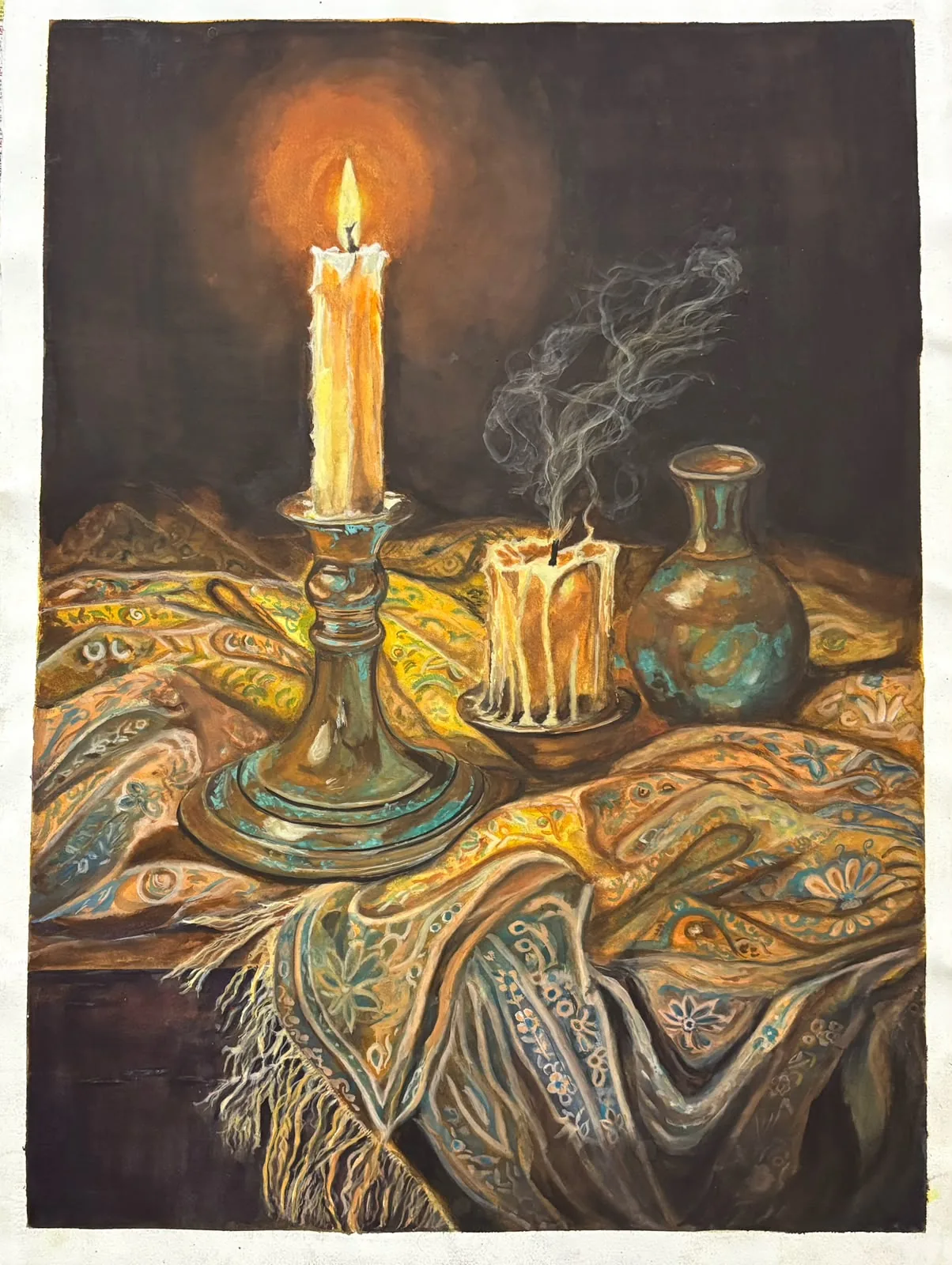
Candle Light, watercolour
Candle Light, a watercolour still life by Ujwal Patil: a tall lit candle glowing against a dark ground, a turquoise-patinated candle holder, a smoking candle stub and a vase, on a shawl dense with paisley and floral pattern
Candle Light · Ujwal Patil · watercolour

Watercolour keeps a record of everything.

The fear I hear most from people who want to learn watercolour is not about the brush. It is about the moment something goes wrong and cannot be undone. That fear is reasonable. Watercolour is transparent. You cannot paint over a mistake the way you can in oil, and the paper remembers every decision you make on it.

So I want to show you a mistake. A real one, on a real painting, by a student who has been learning with me for about two years. And I want to show you what she did with it.

Ujwal calls Candle Light a study of light, warmth and stillness. A tall candle burning, a second one just blown out, its smoke still curling, a vase, and a shawl thrown across the table. Look at the shawl for a moment. It matters more than it seems.

Ujwal Patil smiling, holding her finished watercolour Candle Light in front of her
Ujwal, with Candle Light: the painting she refused to give up on

A mistake, a decision, a design.

The problem

The masking fluid would not come off.

Masking fluid is a promise you make to the paper: a rubbery film painted on to keep it white, peeled away later. Partway through Candle Light, it failed. It left blue marks on the cloth and the candle holder, exactly where light and pattern were meant to live. Ujwal rubbed. She tried a magic eraser. Nothing moved.

“At this stage of the painting that blue masking did not budge to go. There was so much of rubbing, erasing done with magic eraser. But all in vain.”

Ujwal Patil

The decision

Don't hide from the marks. Paint through them.

Most of us, at that moment, reach for a fresh sheet. It feels like the honest thing to do. I suggested something else: find a creative way to cover the blue, and let the painting change its plans instead of abandoning it. The original idea was gone. The question was what the strongest painting could be now, with the marks already there.

“My first instinct could have been to abandon the painting and start again, but Madhubanti’s teaching had already taught me to look at a difficulty not as a mistake, but as an opportunity to find a creative solution.”

Ujwal Patil

The result

Pattern, design and colour, exactly where the blue had been.

She wove new motifs into the shawl and new colour into the candle holder, right over the places the mask had stained. The marks are still under there. You would not find them now. What reads as a richly patterned cloth, with a holder gone turquoise and bronze with age, began as a problem she refused to walk away from.

“I chose to work with what I had. I incorporated additional patterns and design into the fabric and the candle holder. Basically where all the masking fluid had left marks I covered it up with a different design, pattern and colour.”

Ujwal Patil

Detail: the candle holder's base, worked in bronze and bright turquoise patina, with the patterned yellow shawl behind it
Detail · the candle holder, turned turquoise and bronze
Detail: folds of the shawl painted with paisley shapes and pale blue flowers over warm ochre
Detail · motifs painted into the folds
Detail: the shawl's border and fringe hanging over the table edge, patterned with teal leaves and small flowers
Detail · pattern carried down to the fringe

“Looking back at the finished work, I feel particularly happy that I did not give up or start over. I learnt to work with the painting rather than against it.”

Ujwal Patil

A mistake is the next thing to decide about.

Watercolour cannot be erased. That part of the fear is true, and Ujwal proved it with a magic eraser. But a painting is not a test you pass or fail at the first wrong mark. It is a long chain of decisions, and the mark is only the newest link in it.

The skill is not avoiding every mistake. Nobody does. The skill is being able to look at the paper as it actually is, with the mark already there, and still see a strong painting inside it. That takes nerve, and it takes an eye. Both can be trained. Most of what I teach is exactly that.

I want to be careful here. Not every accident is secretly a gift, and some paintings really should be started again. But that ought to be a decision you make with clear eyes, not a reflex you obey because you were frightened.

Once she decided, it moved quickly.

Ujwal did not arrive with a grand plan. She came to one workshop, and then she decided. Once she had, each step followed the last more quickly than she expected. That is how real learning tends to look from the inside: the slow part is making up your mind, not the growth that comes after.

“…the transformation what I see in myself is really a one step upward towards my art journey.”

Ujwal Patil

  1. About two years ago

    One workshop

    Her journey with GoldBrush began with a single workshop. From there she kept going, step by step.

  2. Today

    The Watercolor GrandMasters Fellowship

    Watercolor GrandMasters Fellowship crest

    Today she is in the Watercolor GrandMasters Fellowship, the academy's long-arc mentorship for serious artists building mastery and a professional body of work. Alongside the painting, she is growing as an entrepreneur.

Five things people believe before they start.

And what one painting, and one student, have to say about each.

The belief

“Watercolour can't be corrected.”

What happened

Half true. It cannot be erased; Ujwal tried, with a magic eraser. But it can be answered. Her correction was not a removal. It was a new decision painted on top of the old one, and the painting is richer for it.

The belief

“One mistake means starting again.”

What happened

That was her first instinct too. She chose otherwise, and the result is the painting at the top of this page. Starting again is sometimes right. It should be a choice, not a reflex.

The belief

“It takes years before you see results.”

What happened

Ujwal went from a single workshop to the Watercolor GrandMasters Fellowship in about two years. Growth does not take years once you decide to take the right step; from there it accelerates. The real delay is the hesitation, the time spent still deciding whether to go ahead.

The belief

“I'm not talented enough for this.”

What happened

Nothing in this story depends on talent. It depends on deciding to begin, on showing up once she had, and on the moment the paper refused her, when she kept going. She says the painting taught her problem-solving and perseverance through art. Those can be learned.

The belief

“Art can't become a business.”

What's happening

I won't promise anyone an income; no honest teacher can. What I can tell you is that Ujwal is working on exactly this question right now, building a professional body of work in the Watercolor GrandMasters Fellowship, because growing as an entrepreneur matters to her as much as growing as a painter.

Candle Light is all shadow. This one is all daylight.

A little girl and a puppy at the shore, a wave breaking white behind them, wet sand catching the colour of the sky. Different light, different problems. The same patience.

Watercolour by Ujwal Patil: a curly-haired little girl in a floral dress and a pink polka-dot bow kneels at the water's edge, reaching toward a golden puppy, with a white-capped wave behind them
Ujwal Patil · watercolour
Ujwal Patil smiling, holding her finished watercolour Candle Light
Ujwal with Candle Light

Ujwal, in her own voice · 1 min 36 s

“More than a finished artwork.”

“This painting is more than a finished artwork for me; it represents a chapter of learning, discovery and personal growth.”

Ujwal Patil

“I would wholeheartedly recommend her academy to anyone who wishes to learn art—not simply as a skill, but as a form of expression, mindfulness and self-discovery.”

Ujwal Patil

I didn't paint those patterns.

And I would not have painted them the way she did. What I did was tell her the painting was not finished being possible. That is most of a mentor's work: not holding the brush, but seeing what is still open when the student can only see what went wrong.

A tutorial can show you a technique. It cannot look at your paper on the day the masking fluid fails and tell you what to do next. That is why GoldBrush is built around mentorship, not tutorials.

“Her teaching goes beyond techniques and brushstrokes. She encourages us to observe closely, understand the essence of what we see, experiment fearlessly and, most importantly, develop our own artistic voice.”

Ujwal Patil, on Madhubanti Mukherjee

Meet the mentor

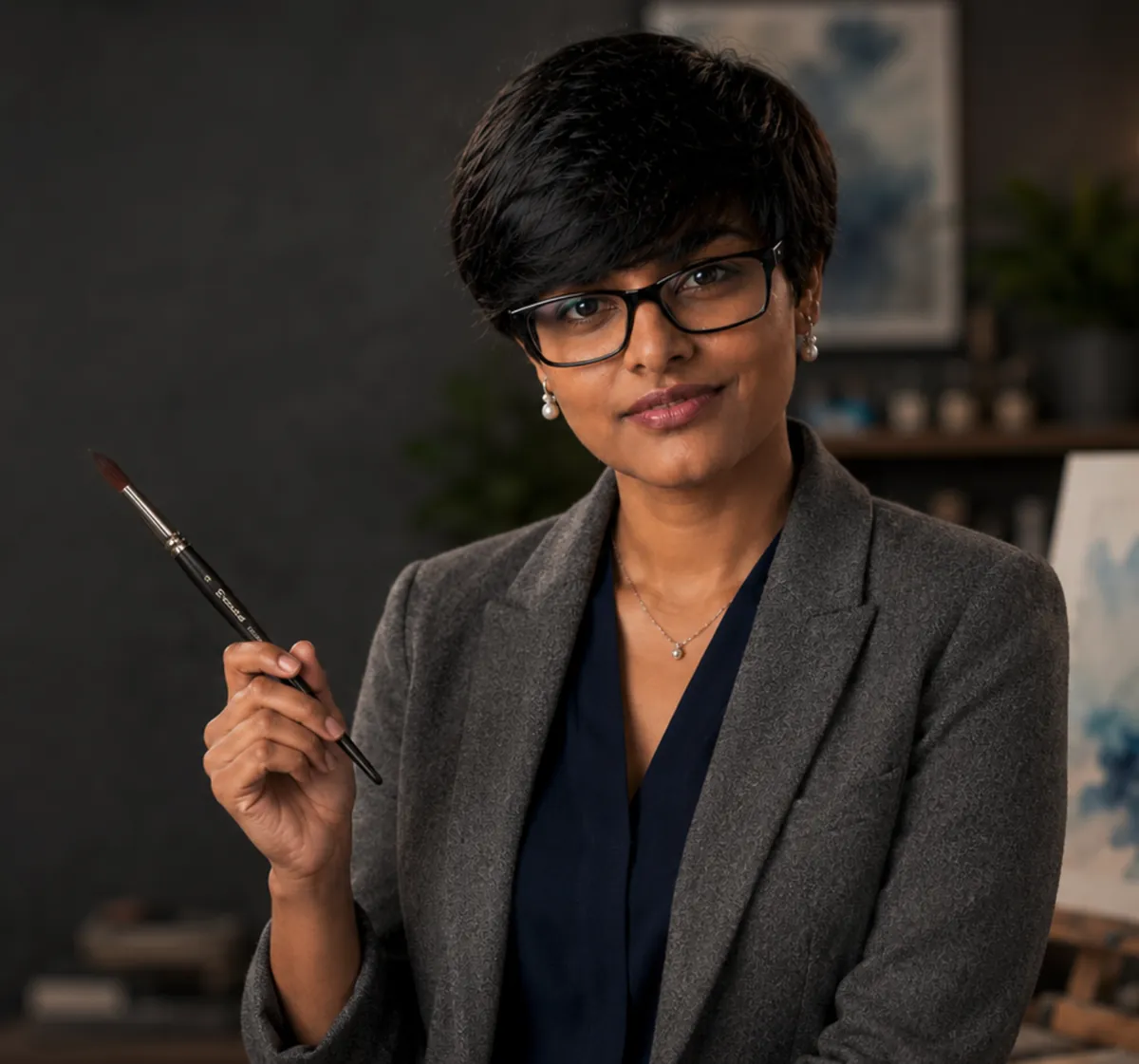
Madhubanti Mukherjee, founder and mentor of GoldBrush Academy, holding a watercolour brush in her studio
Madhubanti Mukherjee · founder and mentor

Start the way Ujwal did.

One live workshop, online. One painting, start to finish, with me beside you on the screen. If it suits you, there is a path after it. If it doesn't, you have still made a painting.

Shishir: Jewel of the Dawn

A crimson sunbird at dawn, painted live together over three evenings.

  • Live on Zoom
  • 30 & 31 October and 1 November 2026
  • 7–9 PM IST each evening
  • ₹399
See the Shishir workshop

The programs

The Watercolor Mastermind, the Artessa Accelerator and the Watercolor GrandMasters Fellowship: mentored learning for people who want to keep going.

Know someone who's afraid of the first wrong mark? Send them this.

← Back to the Student Gallery